

News
Check out what has been happening in Utah Golf.
Utah Male Golfer of the Decade: Tony Finau
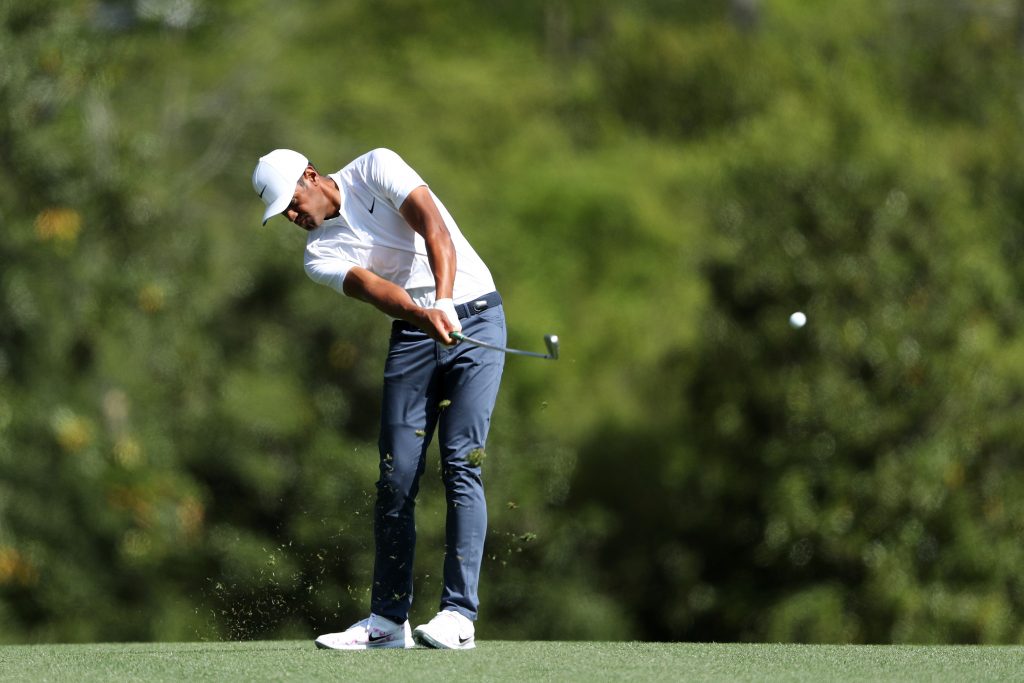
(Photo: Getty Images)
Utah Male Golfer of the Decade: Tony Finau
By Kurt Kragthorpe
When this decade began, Tony Finau thought he had missed his big break in golf. He had just finished second in the 2009 “Big Break” competition that offered $50,000 in prizes and access to a PGA Tour event.
Ten years later, it is evident that Finau has created his own breaks and fully capitalized on them, making him the Utah Male Golfer of the Decade.
“I’m extremely humbled to receive this award and be recognized in this way,” Finau said. “There are many worthy and amazing candidates, and I’m grateful to have been selected. I’m proud to represent the great state of Utah on the world stage and showcase all the beautiful things we have to offer.”
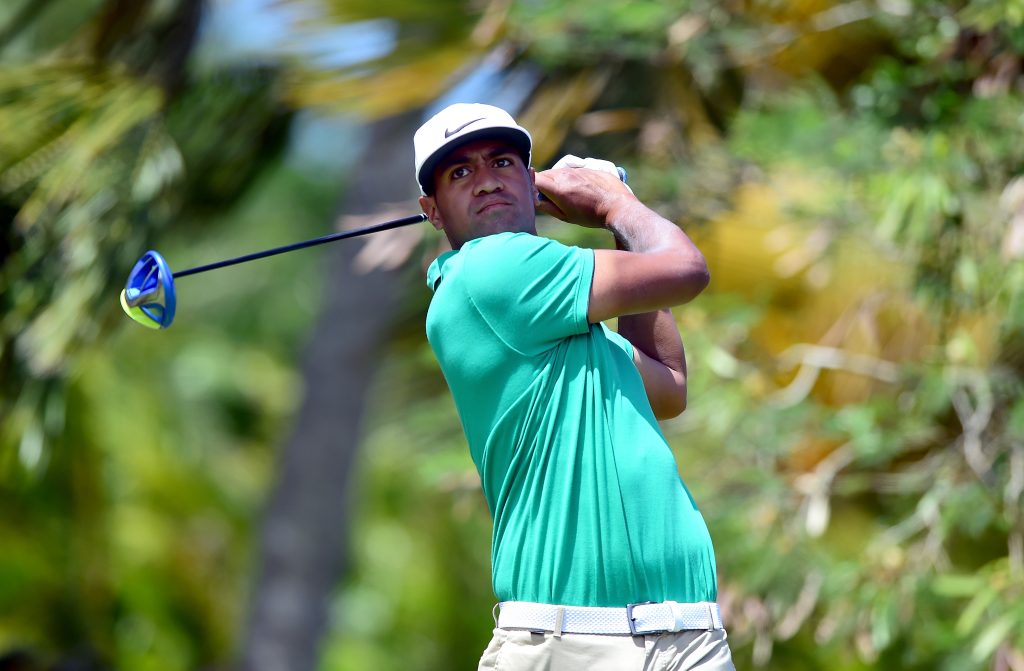
(Photo: Getty Images)
The graduate of Salt Lake City’s West High School, having turned 30 in September, has made nearly $17 million as of the early stages of his sixth PGA Tour season. He won a PGA Tour event and has excelled in major championships, while being picked for U.S. teams in the 2018 Ryder Cup and the 2019 Presidents Cup.
Finau has remained true to his upbringing in the Rose Park neighborhood, providing support through the Tony Finau Foundation. He has ranked high on multiple lists of the nicest players on the PGA Tour and is a proud representative of Utah and the broader Polynesian community.
And his career trajectory suggests he’s just getting started. The upcoming decade could produce even bigger and better things for him in golf.
After that missed opportunity in the “Big Break,” Finau’s breakthrough came in the new format of qualifying for what then was called the Web.com Tour (now the Korn Ferry Tour). He was part of the generation that no longer went to the PGA Tour Qualifying Tournament. Instead, they qualified for the developmental tour, with the chance to play their way onto the big tour via season-long performance.
Finau got there by winning the Stonebrae Classic in northern California in 2014, securing his PGA Tour card for the 2014-15 season. It was an emotional step for Finau, remembering the sacrifices of his mother, Vena, who had died in an auto accident, and everything he had gone through with his own family in an effort to make it.
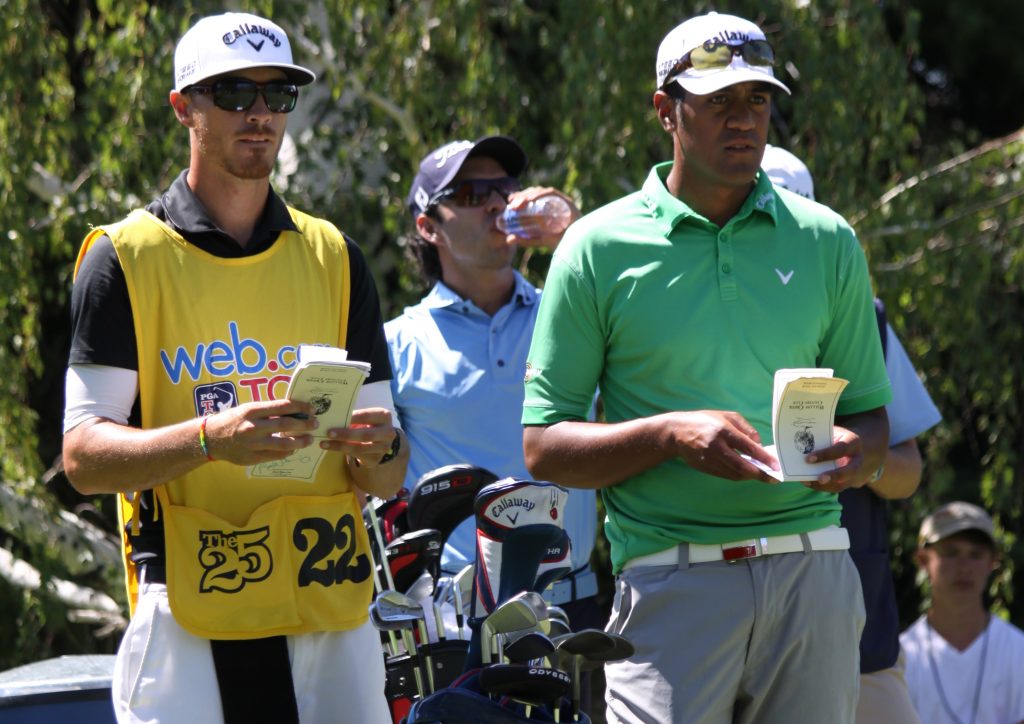
(Photo: Fairways Media)
“Six years of mini-tour golf … just trying to stay competitive, trying to stay afloat financially,” Finau reflected at the time.
Through it all, he said, “I never doubted myself.”
Other snapshots of Finau’s development stand out, once he reached the PGA Tour and immediately thrived. Here are three of those moments:
The 2015 PGA Championship: With the waters of Lake Michigan to his left and a throng of fans to his right, Finau marveled at his view of the PGA Championship from the 17th tee at Whistling Straits in Wisconsin. The Jordan River Par 3 never looked like this.
“Man, this is awesome,” Finau thought.
He grew up in Salt Lake City’s Rose Park neighborhood, learning to play the game on a par-3 course that now barely resembles its old self, with the greens overgrown and baskets designed as targets for discs the only suggestion of a former golf venue. And there stood Finau, playing in the third-to-last twosome of a major tournament, trying to capture the scene permanently in his mind.
“I really cherished it,” he said, “because it’s what I’ve wanted for my whole life, to be in that atmosphere.”
Finau briefly was tied for the lead in third round at Whistling Straits. He made some mistakes the rest of the way, but gathered himself during Sunday’s back nine and finished in a tie for 10th place.
“It was evident to me at the PGA Championship that the way my game is progressing … I can become one of the best players in the world. I strongly believe that,” Finau said later that month.
That has proven to be true.
(Photo: Getty Images)
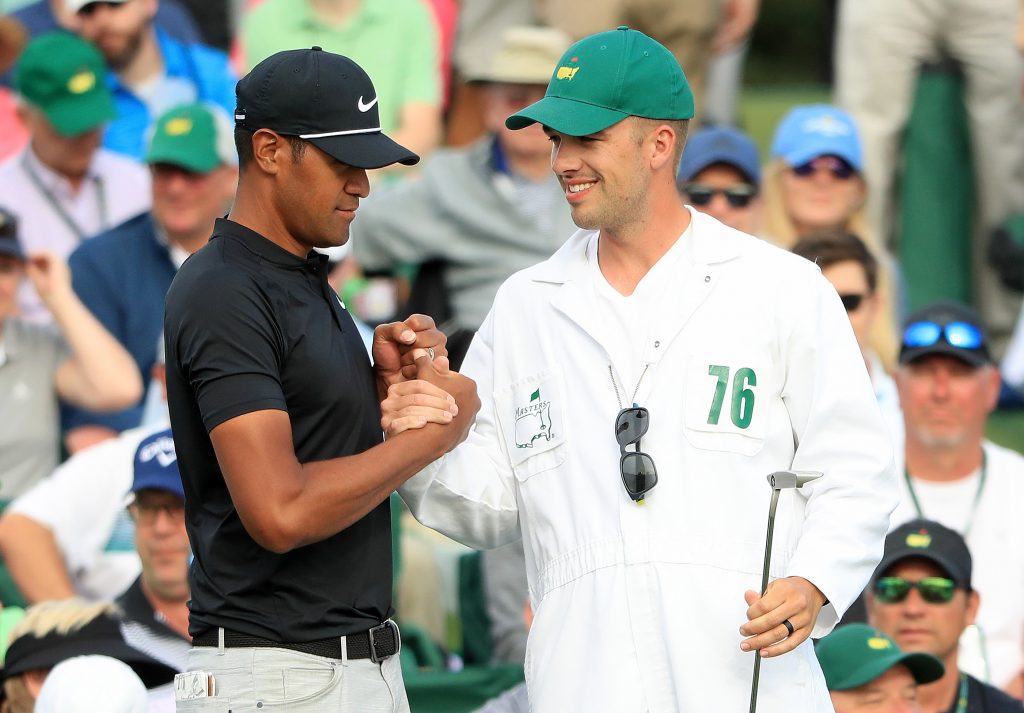
The 2018 Masters: Finau knew he belonged in the field at Augusta National Golf Club, where he tied for 10th in a first Masters appearance that was memorable for multiple reasons.
“I just confirmed that to myself this week,” he said. Everybody else should have become a believer in him, whether the best evidence was Thursday’s 68 after he injured his ankle in Wednesday’s Par 3 Contest or Sunday’s 6-under-par 66 that seemingly came out of nowhere, the way he was missing fairways and greens through 11 holes. Finau proceeded to make six straight birdies.
(Photo: PGA of America)
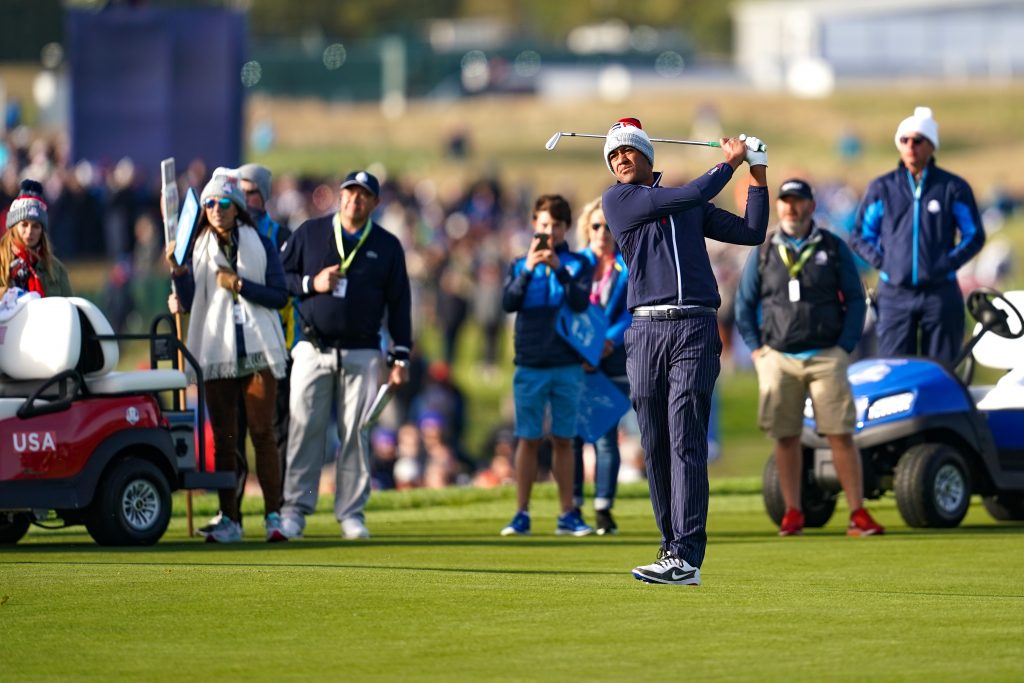
The 2018 Ryder Cup: Finau played for the losing team in his first Ryder Cup appearance, but he performed very well in Paris. Finau dominated Tommy Fleetwood, formerly one of Europe’s hottest players, in a singles match on that Sunday at Le Golf National, winning the last five holes of the front nine in an eventual 6-and-4 victory. Playing in three matches of the competition, Finau produced two points in the Americans’ 17½-10½ loss.
“I played incredible golf today,” Finau said. “I was controlling the ball nicely and I made some putts … Just really pleased with my performance [Sunday] and throughout the week.”
That’s the kind of skill and demeanor he will bring to the Presidents Cup, another case of fulfilling his quest to play for American teams year after year.
He loves playing for the United States and, on a more personal level, his home state of Utah.
(Kurt Kragthorpe is a Salt Lake Tribune sportswriter and a frequent contributor to Fairways Media.)
News
Check out what has been happening in Utah Golf.
Utah Female Golfer of the Decade: Kelsey Chugg
*Editor’s note*
Utah’s leading golf journalists and golf association administrators were recently polled to determine Utah golf’s top 10 stories of 2019 and the female and male golfers of the decade. You can find all of the stories and player profiles in the November issue of Fairways 18 digital magazine here: https://tinyurl.com/r8nmbsv We will also highlight the stories on the website and our social media pages over the next two weeks beginning today with the Utah Female Golfer of the Decade. Many thanks to Kurt Kragthorpe and Fairways Media for providing our content.
(Photo Credit: USGA)
Utah Female Golfer of the Decade: Kelsey Chugg
By Kurt Kragthorpe
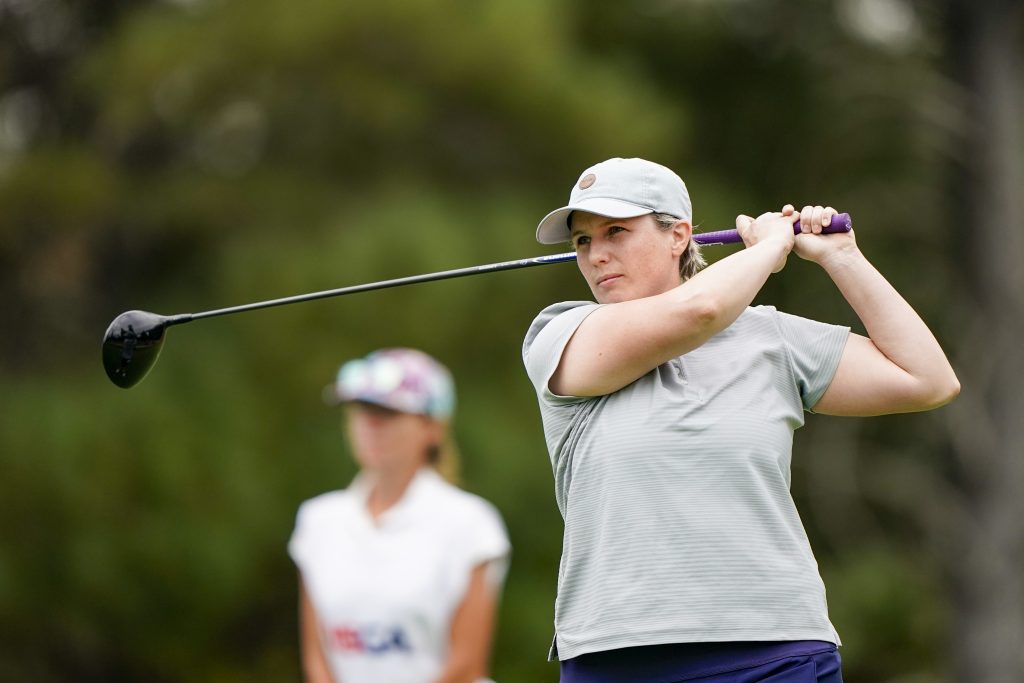
Saying that Kelsey Chugg came out of nowhere to become the Utah Female Golfer of the Decade would overlook how she was the No. 9-ranked women’s junior college golfer in the country in the fall of 2010. Yet considering she was playing in Oklahoma, after having attended high school in Arizona, hardly anyone could have foreseen what a return to her Ogden roots would mean to the development of her game and her prominent place in the Utah golf community.
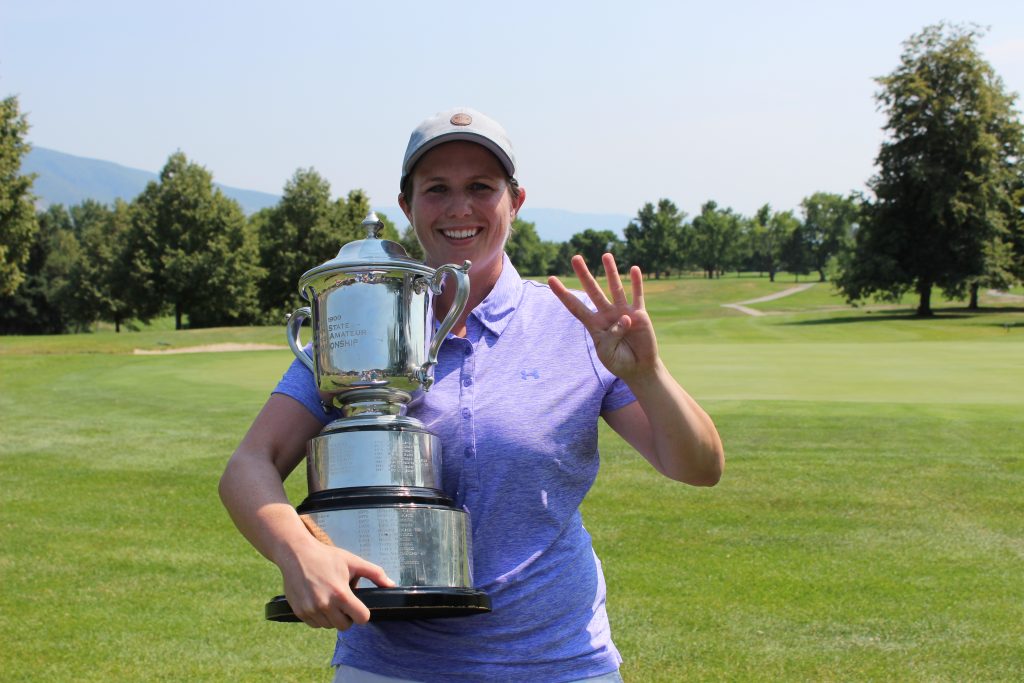
Chugg’s joining Weber State’s golf team after playing for Redlands Community College in Oklahoma led to her becoming a four-time Women’s State Amateur winner, a United States Golf Association champion and a staff member of two golf administrations in Utah.
(Photo Credit: Fairways Media)
Chugg has established herself as one of the greatest match-play golfers in Utah history, male or female. Her four wins in the Women’s Am all have come since the event’s format returned to match play, and she went 11-1 in consecutive years of the U.S. Women’s Mid-Amateur, winning the 2017 title and then finishing second after an epic final match.
Those achievements came while she was devoted to her job as the UGA’s membership director, and now she’s the assistant director of Salt Lake City Golf.
“Utah golf means so much to me, and I’m humbled and honored to be chosen as the Female Golfer of the Decade,” Chugg said, “especially with someone as accomplished and talented as Tony (Finau) being chosen as the Male Player of the Decade.”
Looking back, Chugg said, “My game has come a long way in the past 10 years, thanks to my coach, Lynsey Myers, and my coach at Weber State, Jeff Smith, and my teammates. I’ve had many great opportunities to locally and nationally, and I believe the the championships the UGA hosts and the level of competition in Utah women’s golf helped prepare me for all levels of play.”
That became evident in 2017, when Chugg won the U.S. Women’s Mid-Amateur at Champions Golf Club in Houston. That week exemplified her game and her determination in multiple ways, while reminding everyone just how good she is in match play.
She went there as a four-time winner of the Utah Women’s State Amateur, Chugg becomes “like a different person” in match play, Myers said. “I’d put her up against anyone.”
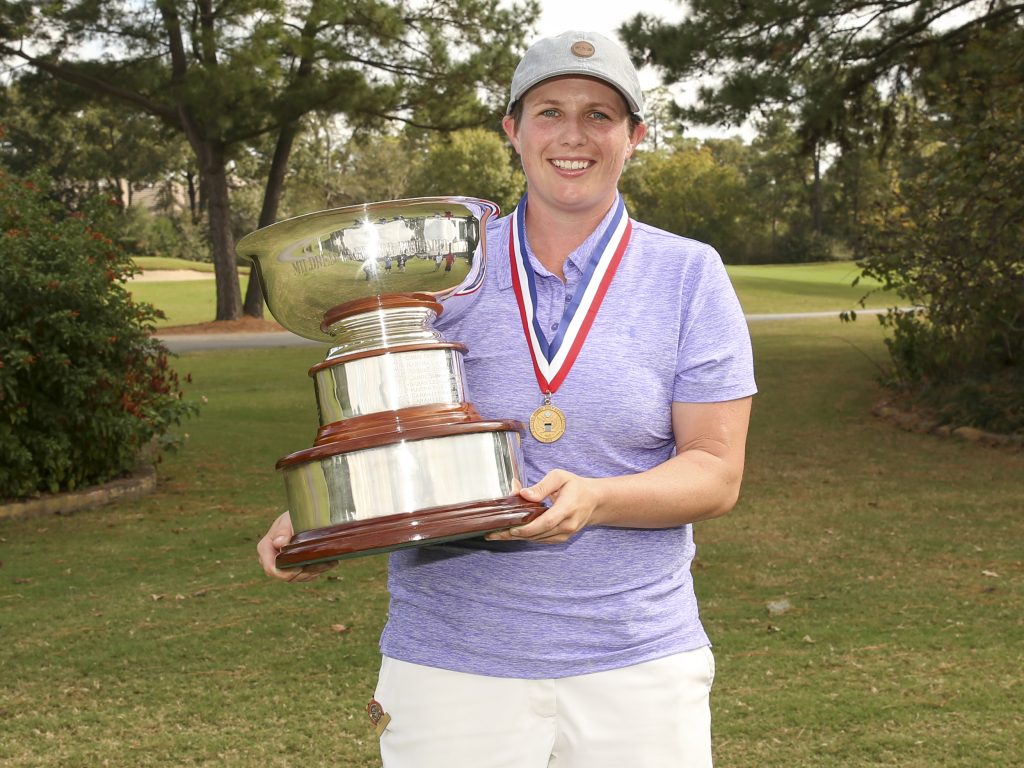
(Photo Credit: USGA)
The summary of the Women’s Mid-Am, for golfers 25 and older, is how Chugg dominated her six opponents in match play. The back story is even better, including how she opened the stroke-play portion of the tournament with an 85, cried in the parking lot, then practiced for a while and drove to the home where the tournament provided her housing.
The host family? Absent, while asking the visiting golfer to watch their cat.
She shot a 72 the next day to qualify for match play, and then reeled off six straight victories.
Chugg is a self-described “blue-collar person” and “golf nerd.” Raised by a mother who moved frequently, she grew up mainly in California and Arizona and spent summers with her grandparents in the Ogden area. Merlin Judkins, a relative, would take her to Davis Park Golf Course and Schneiter’s Riverside. “That’s how we sort of bonded,” Judkins said. “You could tell she was athletic; you could tell she loved the game.”
Judkins is one of many strong influences in Chugg’s golf development. She worked at a semi-private course in Arizona, where noted instructor Kene Bensel took an interest in her. She became a junior college star at Redlands, becoming even more devoted to the game, and thrived for two years in Weber State’s program, coached by Smith, who died in 2016.
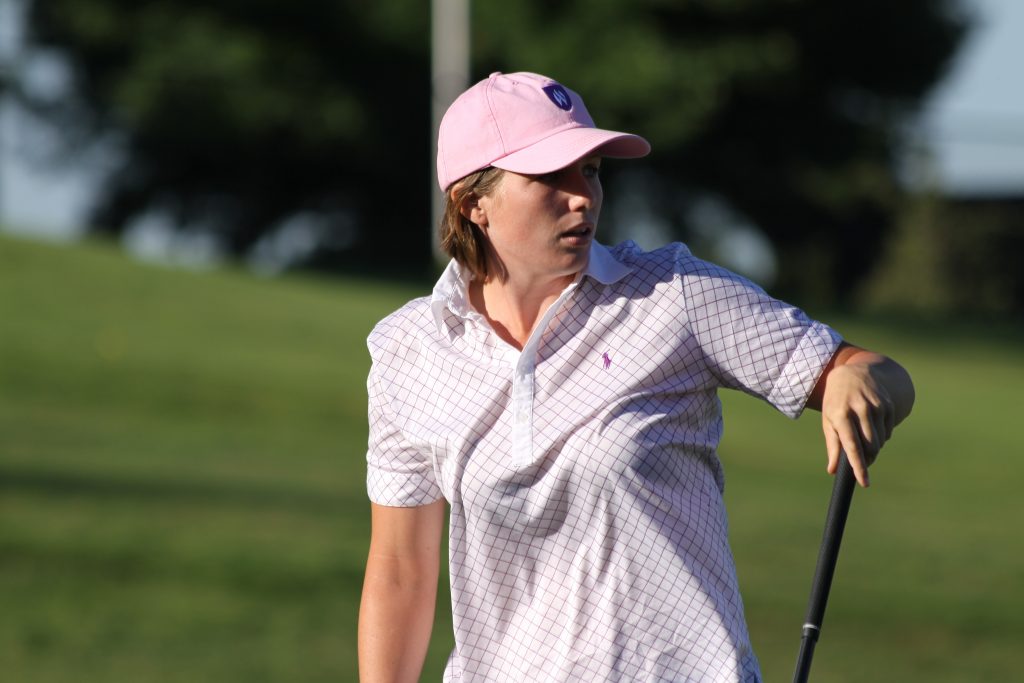
(Photo: Fairways Media)
People like to help her. In Houston, where Myers counseled her by phone after that poor opening round, Chugg benefitted from having Don Goldberg, the husband of Utah golfer Annette Gaiotti, caddy for her in the second round. As the father of an Olympic skier, “He knows a lot about the mental game,” Chugg said. “He definitely kept me calm.”
The next year, Chugg nearly became the first golfer who was living in Utah at the time to claim a second USGA title. Even in a losing effort, she demonstrated those trademark qualities of hers. Chugg won two sets of three consecutive holes, yet ended up losing the final match of the Women’s Mid-Amateur at Norwood Hills Country Club in St. Louis.
Shannon Johnson of Massachusetts birdied the 18th hole for a 1-up victory. Chugg twice was 2 down, but immediately responded each time by winning the next three holes in a match that featured five lead changes. The second run sent her 1 up through No. 15, but Johnson tied her with a birdie on the par-4 No. 16 and then won with another birdie on the par-5 No. 18. Chugg’s 10-foot birdie attempt slid past the hole.
She’ll always wonder what would have happened if she had made that putt and gone to extra holes, and the loss hurt because she knew what she was missing, after enjoying a year of all the opportunities that being a USGA champion created for her.
The best part about watching Chugg’s golf career evolve is how she maintains a high-level game while remaining devoted to her jobs. She’s an amateur golfer, with a professional work ethic. And much like Tony Finau, she may be tough to beat in the coming decade as well.
(Kurt Kragthorpe is a sportswriter for the Salt Lake Tribune and a frequent contributor to Fairways Media)
News
Check out what has been happening in Utah Golf.
Celebrating 125 Years of Golf in Utah

Utah native George Von Elm (right), who lost a U.S. Open playoff to Billy Burke in 1931 and won the 1926 U.S. Amateur, won his state’s amateur.
This story originally appeared on the USGA’s website on May 26, 2012. It has been slightly modified and updated.
Long before he would defeat Bob Jones in the 1926 U.S. Amateur, George Von Elm just wanted to win the Utah State Amateur. The tournament meant everything to golfers in Utah in those days, and not much has changed. From its founding in 1899 through the 2019 event, the State Am will have been contested for 121 consecutive years, making it the longest continuous golf tournament in the world.
The State Am is the tournament that has paired brothers against one another, produced father and son champions, showcased a female star, dealt with occasional controversy and just kept going all these years, including when America was involved in World Wars I and II.
If you’re wondering why the State Am was played during world wars, when major championships such as the U.S. Open and the British Open were ceasing operations, the answer is both practical and emotional.
During World War II, in particular, the event provided a playing opportunity for soldiers stationed in Utah. Beyond that, it is apparent that continuing to stage the State Am was very meaningful to the Utah Golf Association.
“They did anything to keep it going, to keep that record intact,” said Ralph Emery, a longtime golf professional whose father, Al, was the tournament chairman in 1943. “They took a lot of pride in that.”
Longevity aside, the championship’s greatest characteristic is how deeply golfers care about the event and its tradition.
The State Am did not begin with Von Elm, but he’s a good place to start. Salt Lake City’s Forest Dale Golf Course is a modest, nine-hole layout, but it once was the center of Von Elm’s golfing universe. Then operated as The Country Club, the course is where Von Elm caddied and shagged balls and developed his game as a teenager.
In 1917, he won the first of his three State Am titles on that course at age 16, launching a legendary amateur career.
His brother, Roy, once said that the experience of winning State Am matches prepared Von Elm for greater challenges, such as taking on Jones in the U.S. Amateur. Von Elm upset Jones in the 1926 final at Baltusrol Golf Club in Springfield, N.J., delivering Jones’ only defeat in a five-year period of the championship (Jones won in 1924, 1925, 1927, 1928 and 1930). After turning pro, Von Elm also competed in several U.S. Opens, including a runner-up finish in 1931, the longest playoff in the event’s history.
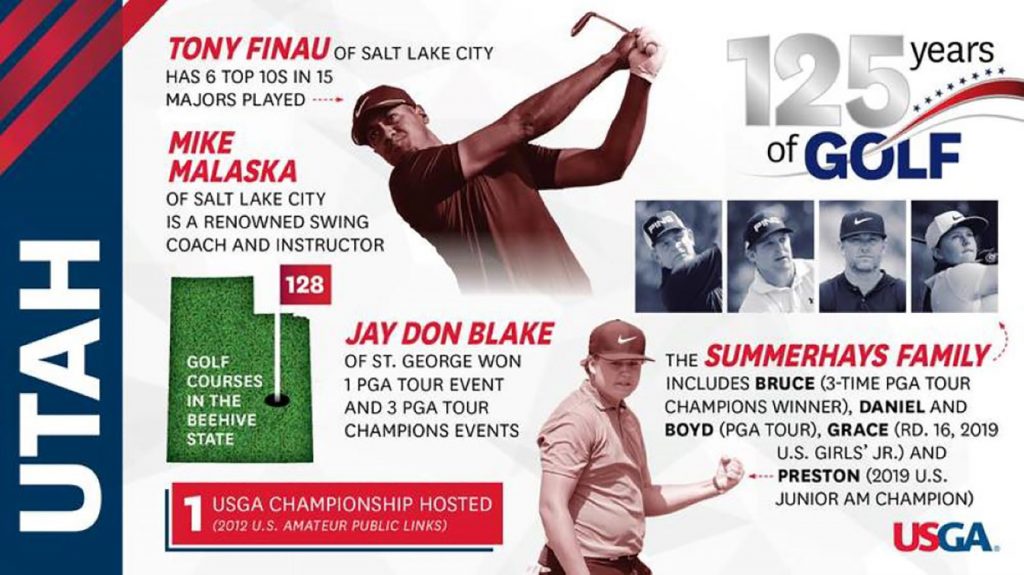
There is considerable competition for the title of first family of Utah golf, but the Summerhays clans would be tough to beat. The State Am has paired two sets of Summerhays brothers against one another. In 1966, Bruce Summerhays beat his brother Lynn in the semifinals on his way to the title.
“The State Am was something I always wanted to win,” said Bruce Summerhays, who went on to win three events on the PGA Tour Champions. “It really pushed me into wanting to play and knowing I could play really good golf.”
The next generation matched Lynn’s sons, Daniel and Boyd. Daniel was the defending champion in 2001 at age 17 when he met Boyd in the quarterfinals.
“That’s the most awkward golf experience I’ve ever had,” said Daniel, who edged his bother, 1 up. “Nobody was happy when the match was over, not even me.”
With his brother’s encouragement to make that victory truly meaningful, Daniel went on to win his second title. He has played eight years on the PGA Tour, earning top-10 finishes in both the U.S. Open and PGA Championship in 2017, but has fond memories of the days when merely qualifying for the Utah Amateur and reaching match play was a big achievement.
“Just talking about it brings back some good feelings,” said Daniel. “Whatever talent I had, that’s where it came into fruition.”

Preston Summerhays won the 2019 U.S. Junior Amateur shortly after capturing the Utah Amateur. (USGA/Darren Carroll)
Boyd also has several fond memories of the State Amateur – both as a player and father. His son, Preston, now 17, matched Uncle Danny’s feat of winning back-to-back titles, earning his victories in 2018 and 2019. A week after his win in 2019, Preston also won the 2019 U.S. Junior Amateur at the Inverness Club in Toledo, Ohio.
The State Am’s most memorable brotherly competition came between twins Craig and Kean Ridd in the 1967 semifinals, a 23-hole duel that Craig won on his way to the title. The battle was staged in front of the twins’ father, Jack, also a two-time winner in 1963 and ’64.
The Ridd family’s victories came within a brief span, in contrast to the Blair’s titles. Jimmy Blair (1973) and Zac Blair (2009) each won the State Am in the summer before becoming a Brigham Young University golfer.
Todd Miller, who was in the middle of his BYU career, made the 2004 tournament memorable for reasons other than winning. A son of 1973 U.S. Open champion Johnny Miller, Todd won quarterfinal and semifinal matches on a Saturday to advance to the finals. Rather than play golf on a Sunday, which conflicted with his religious beliefs, Miller announced he would forfeit the match to Clark Rustand.
After some deliberation in the months that followed, the UGA decided to maintain the traditional schedule of a Sunday finish, following stroke-play qualifying on Wednesday and Thursday and two rounds of match play on both Friday and Saturday.
The 2004 event also introduced the first female contestant in tournament history. Awarded a special exemption as the 2002 U.S. Women’s Amateur Public Links champion, Annie Thurman Young advanced to match play and won in the round of 32 before being eliminated. More recently, Grace Summerhays, the younger sister of Preston, qualified for this year’s Utah Amateur.
The bulk of State Am entrants must advance through regional qualifying, which was introduced in 1982 in response to the growth of the event’s popularity. Previously, any golfers who met the required USGA Handicap Index® were eligible to play at the tournament site. The competition annually attracts 700-800 entrants.
In 1967, sportswriter Joe Watts, a lifelong Utahn, declared the Utah State Amateur the greatest tournament in the world. His love for the event eventually led to his becoming a longtime executive director of the Utah Golf Association. While Watts may be biased in his feelings about the State Am, that widely shared belief in Utah makes the tournament what it is.
Kurt Kragthorpe is a columnist for theSalt Lake City Tribuneand was a contributor to the book 100 Years of the Utah State Amateur.
https://www.usga.org/content/usga/home-page/celebrating-125-years-of-golf-in-america/utah.html
News
Check out what has been happening in Utah Golf.
UGA Hosts U.S. Amateur Four-Ball Amateur Championship Qualifier at Entrada

By Randy Dodson
A pair of BYU Women’s golf sophomores and some familiar names from UGA men’s events will represent Utah in the 2020 U.S. Amateur Four-Ball Championships.
BYU teammates Annick Haczkiewicz (L) and Allysha Mateo (2019 Mary Lou Baker Open champion) shot a (-5) 66 Monday at Entrada at Snow Canyon Country Club to claim the qualifying spot for the 2020 U.S. Women’s Amateur Four-Ball Championship at Quail Creek Country Club, Naples, FL.
The duo carded six birdies on the day and counted just one bogey on the Johnny Miller signature design golf course.
“Knowing we will be playing in a USGA event is very special,” said Mateo. “They know how to host great events with stiff competition on some great courses. We got off the tee well today and our ball-striking plays to both of our strengths.
A pair of junior golfers, Lilly DeNunzio and Ali Mulhall finished at even par 71 to grab the first alternate spot. Drew Nienhaus and Nicole Rallo T3 (+1) 72 are the second alternate team.
“We had a lot of fun out there and it felt like just another round playing with each other,” said. Haczkiewicz.
In the men’s qualifier, extra holes were needed to determine the two qualifying teams as Jeff Jolley/Tyson Lund, Andrew and John Sajevic and Ryan Brimley/David Jennings finished with scores of (-6) 65.
The three teams played the par 4 No. 10th and then the par 5 No.11 before the dust settled with the Sajevics (from Nebraska) and Brimley/Jennings securing their tickets to the 2020 USGA Four-Ball Championship at the Philadelphia Cricket Club (Wissahickon Course) in Philadelphia, PA.
“We both missed short birdies on the first playoff hole,” said Jennings. “On the par 5 hole we decided to lay up after Jolley and Lund were in trouble. Par was good enough.”
Jolley/Lund settled for the first alternate position while Denny Job/Ben Jorgensen T4 (-4) 67 were awarded the second alternate spot when Dan Horner/Darrin Overson, who also finished with a 67, didn’t stick around for a playoff.
“The second alternate spot never gets in,” explained Horner.
The U.S. Amateur Four-Ball Qualifier wraps up the 2019 Utah Golf Association tournament season as UGA Director of Rules and Competitions Easton Folster now sets his sights on tournament dates and locations for 2020 UGA championships and USGA qualifiers.
For complete results, please click here: https://www.uga.org/usga-qualifiers/
News
Check out what has been happening in Utah Golf.
2019 Utah Section PGA Awards Announced
SALT LAKE CITY – The Utah Section PGA, experts in the game and business of golf in Utah, released the 2019 Utah Section PGA Awards on October 29th. Highlighting the award-recipient list is Hobble Creek Golf Course Head Golf Professional Craig Norman as Utah Section PGA Professional of the Year.
Annually, the Utah Section PGA forms an awards committee to assist in the selection process of the 14-available awards. Nominees are requested by Utah Section members across the state and then chosen by the Award Committee members and by peer voting.
Award winners are PGA professionals who go above-and-beyond to fulfill the Utah Section PGA’s mission to be a leader in promoting the enjoyment of and involvement in the game of golf. Award recipients are selfless leaders at their own facilities and commonly enjoy opportunities to teach and grow the game of golf in Utah.
2019 Utah Section PGA Awards:
Professional of the Year: Craig Norman, Hobble Creek
Teacher of the Year: Tommy Sharp, Golf Lab
Youth Player Development Award: Jake Wyatt, Gladstan
Assistant of the Year: Jon DeBoer, Tuhaye
Jon Unger Award: Brian Howes, Callaway
Merchandiser of the Year Private: Marty Bauer, Glenwild
Merchandiser of the Year Public: Lynn Landgren, Bonneville
Player Development Award: Bryant Boshard, The Ridge
Superintendent of the Year Public: Tracy Howard, Carbon Golf Course
Superintendent of the Year Private: Paul Stokes, Logan Country Club
Horton Smith Award: Chad Pettingill, Jeremy Ranch
Bill Howard Award: Dale Darling
Bill Strausbaugh: Darci Olsen, Glenmoor
Gentleman Jeff Award: Scott Whittaker
Each award recipient is celebrated at the Utah Section PGA Annual Meeting, February 11-13th in St. George, Utah, alongside the Utah PGA Winter Classic played at SunRiver Golf Club, St. George Golf Club and Sand Hollow Resort.
Norman, DeBoer, Wyatt and Boshard were asked their thoughts when the award list was released:
Craig Norman (Photos attached)
Professional of the Year:
“I had no idea and I may not be deserving of that great honor…If you look at the names on that list over the years, that is a lot to live up to. I am deeply honored and cannot believe it, no, not at all.”
John DeBoer
Assistant of the Year:
“The award reflects an acknowledgment of all assistant professionals within our section. I’ve worked for some amazing head golf professionals throughout my years and hope they know this is a product of their influences.”
Jake Wyatt
Youth Player Development:
“It’s a tremendous honor. I am extremely humbled and grateful to win this award. Junior golf development has always been a passion of mine since entering the PGA… Introducing the game to the next generation is a big motivation. I want our game to be accessible to anyone and everyone. Focusing on junior golf and making a less-intimidating, more-fun oriented program has always been a goal of mine.”
Bryant Boshard
Player Development:
“I became a PGA professional because of my love and passion for the game. The past few years working with juniors, seniors and veterans has shown me the value and joy it brings to not only their lives, but my own as well. My new reason for being a PGA professional is to continue to spread the game to as many people as possible and share the joy and love it brings to my life.”
–
About the Utah Section PGA: The Utah Section PGA was established in 1986 and has 375 members and associates providing golf professional services at 90 facilities throughout Utah. It is the mission of the Utah Section PGA to be a leader in promoting the enjoyment of and involvement in the game of golf. The Utah Section PGA seeks to be a strong and prominent organization within the golf community by providing quality programs and services to both PGA Members and others.
For more information please contact:
Jesse Dodson
Utah Section PGA, Publicist
801-995-0684
News
Check out what has been happening in Utah Golf.
World Handicap System to Roll Out in 2020
LIBERTY CORNER, N.J., and ST. ANDREWS, Scotland (Nov. 4, 2019) – The World Handicap System (WHS) is ready to be launched in January 2020 and will provide golfers with a unified and more inclusive handicapping system for the first time.
Though many countries are planning to adopt the new system in January, the system will go live in other parts of the world throughout the year to accommodate different implementation plans and variations in the golf calendar.
Developed by the USGA and The R&A in close coordination with existing handicapping authorities, the WHS will provide all golfers with a consistent measure of playing ability, with handicaps calculated in the same way wherever they are in the world.
A key objective of the initiative was to develop a modern system, enabling as many golfers as possible to obtain and maintain a Handicap Index. Golfers will be able to transport their Handicap Index globally and compete or play a casual round with players from other regions on a fair basis. It will also indicate the score a golfer is reasonably capable of achieving the next time they go out to play.
The table lists the estimated implementation timeframes for a selection of countries:
| Indicative Time Frame* | Country |
| January | Argentina, Australia, Canada, India, Mexico, Panama, South Africa, Republic of Korea, United States, Uruguay and Venezuela |
| February – March – April | Hong Kong, New Zealand, Singapore and Sweden |
| May – June – July – August | Portugal |
| September – October – November – December | Great Britain and Ireland |
*Subject to change
The WHS has two main components – the Rules of Handicapping and the Course Rating System. The Rules of Handicapping are encompassed within seven Rules to inform administrators and golfers on how an official Handicap Index is calculated and administered, with some flexibility given to national associations based on how the sport is played and enjoyed in their region. The Course Rating System, based on the USGA Course Rating System first adopted nearly 50 years ago and already adopted on nearly every continent, sets out a consistent method of determining a course’s difficulty. Together, these components become the foundational elements in determining a golfer’s Handicap Index.
“When the golf community works together, everyone benefits,” said Mike Davis, CEO of the USGA. “We have seen the benefit that handicapping has provided for decades, providing greater enjoyment for all who play. To have a single set of Rules of Handicapping for the game will connect golfers from country to country, and we are excited to bring the best of all worlds together through this initiative.
“It is one of the many ways we are investing in golf’s future, to strengthen and foster growth of the entire game for years to come.”
Martin Slumbers, Chief Executive of The R&A, said, “The game of golf is transforming to meet the needs of the modern-day golfer; modernizing the Rules this year was an important step forward in that regard and the World Handicap System will be another.
“Our hope is that the launch of the WHS will be a catalyst for change; signalling the start of a new era of golfer engagement, being inclusive by embracing all golfers, whatever their level of ability, and broadening its appeal to a much wider audience.”
“Change also means opportunity and, managed appropriately, this can only be good for the game. It does mean there will be a period of adjustment, as we saw with the new Rules, but once it beds in golfers and golf clubs will benefit in many ways from the new system.”
In preparation for the launch of the WHS, more than 3,000 golf courses have been rated for the first time and an extensive education program has been delivered. By the end of 2019, more than 90 National Associations will have attended an educational seminar and a robust library of resources is hosted on WHS.com to support regional education.
Rules of Handicapping books are being produced and will be translated and delivered through national associations.
In addition, the USGA and The R&A have developed a series of golfer-focused materials, including videos, infographics and posters, which can be used by national associations and shared with golf clubs for the benefit of golfers.
This includes a promotional video which can be seen here featuring Annika Sorenstam, Gary Player and voices of recreational golfers from around the world to encourage as many golfers as possible to obtain and maintain a handicap.
The materials explain the system’s key features, including:
- Flexibility in formats of play, allowing both competitive and recreational rounds to count for handicap purposes and ensuring that a Handicap Index reflects demonstrated ability
- A minimal number of scores needed to obtain a new handicap; with the number of scores needed to obtain a new handicap being 54 holes from any combination of 18-hole and 9-hole rounds (with some discretion available for national or regional associations)
- An average-based calculation of a handicap, taken from the best eight out of the last 20 scores and factoring in memory of demonstrated ability for better responsiveness/control
- A calculation that considers the impact that abnormal course and weather conditions might have on a player’s performance each day
- Timely handicap revisions
- A limit of Net Double Bogey on the maximum hole score (for handicapping purposes only)
- A maximum handicap limit of 54.0, regardless of gender, to encourage more golfers to measure and track their performance to increase their enjoyment of the game
The formation of a World Handicap System was first conceived in 2011 between the USGA and The R&A in an effort to engage more golfers in the game and promote equity, no matter where golf is played. The effort unites six existing handicapping systems into one, while embracing the many ways the game is played across cultures.
Beginning in 2020, the new WHS will be governed by the USGA and The R&A and administered by national and regional golf associations around the world.
The existing six handicapping authorities, Golf Australia, the Council of National Golf Unions (CONGU) in Great Britain and Ireland, the European Golf Association (EGA), the South African Golf Association (SAGA), the Argentine Golf Association (AAG) and the USGA, represent approximately 15 million golfers in 80 countries who currently maintain a golf handicap.
As an extension of their support of the Rules of Golf worldwide, Rolex has made a commitment to support the USGA’s and The R&A’s efforts to implement the World Handicap System.
To learn more about the World Handicap System, please visit WHS.com. For WHS information specific to a country, use the Association Finder for further information.
About the USGA
The USGA conducts the U.S. Open, U.S. Women’s Open, U.S. Senior Open and the U.S. Senior Women’s Open, as well as 10 amateur championships and international matches, attracting players and fans around the world. Together with The R&A, the USGA governs the game worldwide, jointly administering the Rules of Golf, Rules of Amateur Status, equipment standards and World Amateur Golf Rankings, with a working jurisdiction in the United States, its territories and Mexico.
The USGA is one of the world’s foremost authorities on research, development and support of sustainable golf course management practices. It serves as a primary steward for the game’s history and invests in the development of the game through the delivery of its services and the work of the USGA Foundation. Additionally, the USGA’s Course Rating and Handicap systems are used on six continents. For more information, visit www.usga.org.
About The R&A
Based in St Andrews, The R&A runs The Open, elite amateur events, international matches and rankings. Together The R&A and the USGA govern the sport of golf worldwide, operating in separate jurisdictions but sharing a commitment to a single code for the Rules of Golf, Rules of Amateur Status and Equipment Standards. The R&A, through R&A Rules Ltd, governs the sport worldwide, outside of the United States and Mexico, on behalf of over 36 million golfers in 143 countries and with the consent of 158 organisations from amateur and professional golf.
The R&A is committed to working for golf and supports the growth of the sport internationally and the development and management of sustainable golf facilities. For more information, visit www.randa.org.